
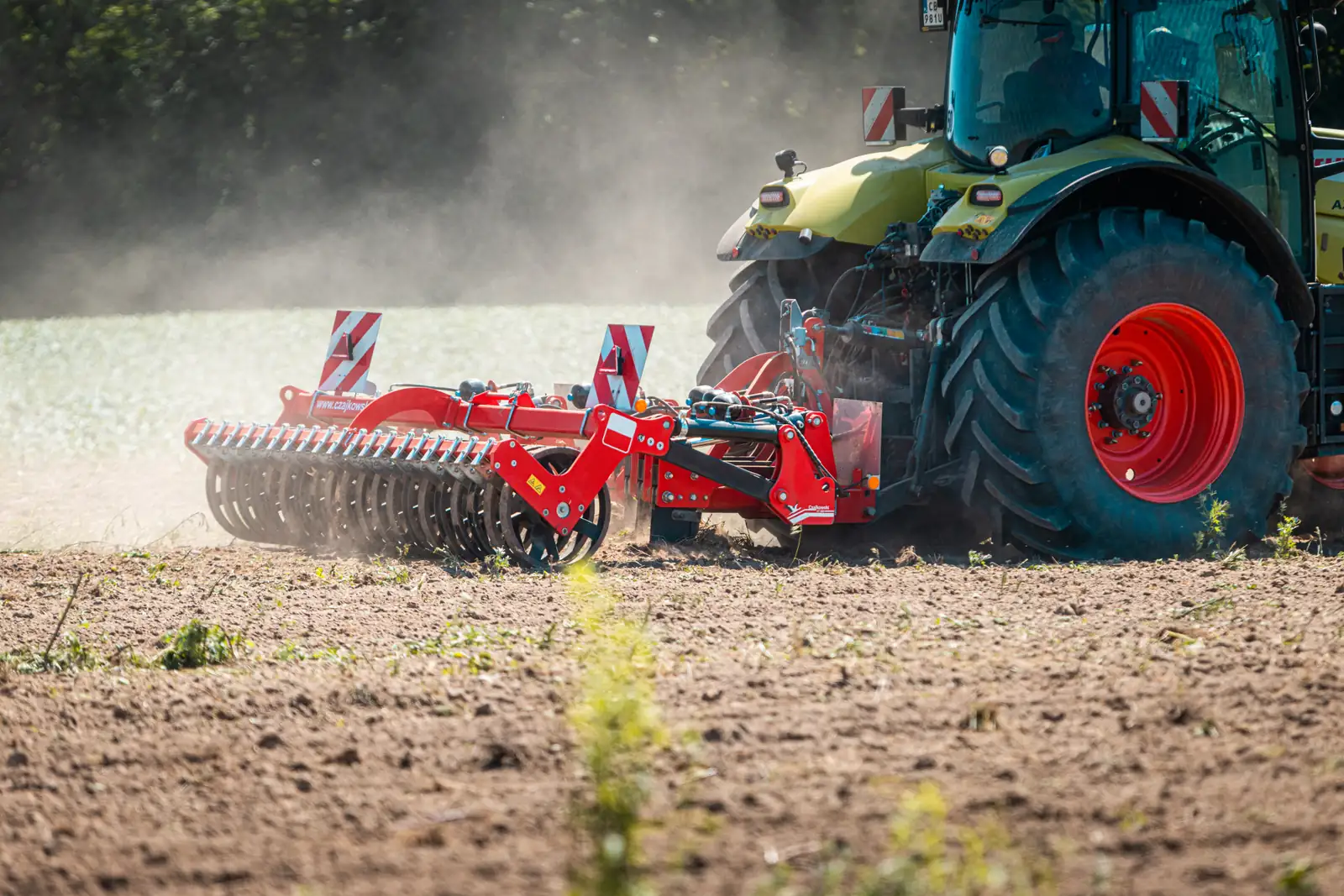
What are the benefits of subsoiling? Discover 3 key advantages for your field
Subsoiling is a key agrotechnical procedure that destroys the impermeable plough pan, restoring deep soil aeration and water storage capacity. Removing this barrier is the foundation for strong plant root growth and protecting yields against drought. By using modern machines, such as the Czajkowski VT 300 subsoiler, work proceeds without troublesome clogging by post-harvest residues. Discover the three most important benefits of subsoiling and check how this one procedure can increase the profitability of your crops.
What is subsoiling and when is it worth performing?
Subsoiling is mechanical loosening of the soil without furrow inversion, aimed at destroying the compacted plough pan. The procedure should be performed after harvest, especially when waterlogging occurs in the field and field penetrometer testing shows heavy soil compaction.
Long-term, traditional ploughing and heavy equipment create an impermeable barrier that drastically inhibits root development. Eliminating this layer restores the proper water and air balance in the soil, which is the foundation for high and healthy yields.
What does field subsoiling do? 3 key benefits for crops
Subsoiling retains rainwater in the soil, facilitates root penetration of deeper layers and eliminates waterlogging. Breaking the hard plough pan supports the restoration of crumb structure and stimulates a multiple-fold increase in the earthworm population. The corridors created by them act as natural drainage, which improves water infiltration into the root zones.
1. Increased water retention and drought protection
Subsoiling increases retention by directing rainwater directly to the deepest reservoirs in the soil. Using the appropriate loosening aggregate reduces surface runoff of rainwater.
Additionally, mulch and post-harvest residues left on the surface lower the soil temperature in summer, reducing the evaporation phenomenon. Thanks to this, plants receive constant access to water reserves during periods of drought.
2. Deep rooting and better access to fertilizers
Destroying the plough pan opens the way for roots to lower parts of the soil, which are rich in previously leached nutrients. Vertical cutting of the soil forces the plant to grow strongly downwards, which leads to increased yields.
The absence of a plough pan provides crops with:
- Uptake of macro- and micronutrients from greater depths
- Stem stabilization, which prevents lodging during strong winds
- Natural plant resistance to sudden temperature spikes
3. Elimination of waterlogging after heavy rain
The subsoiler effectively drains the field by cutting through the compacted layer that blocks the free flow of water. Such action removes waterlogging, which cuts off oxygen and leads to the suffocation of the root system in the flooded area. Smooth water infiltration deep into the soil profile protects the most fertile layer from leaching, reducing total soil loss due to erosion.
Czajkowski VT 300 subsoiler - rapid elimination of the plough pan
The Czajkowski VT 300 subsoiler is a device designed for vertical soil penetration below the compacted layer, used to break the plough pan. The machine's design is based on fully mechanical solutions and is intentionally devoid of electronic sensors, which prevents service downtime.
The frame arrangement, meanwhile, allows for the free flow of lifted organic mass, solving the problem of troublesome clogging of the aggregate in stands with a large amount of post-harvest residues.
Key technical parameters of the VT 300 model
The continuity of work and efficiency of the subsoiler result from a precisely designed frame and modernized control systems. Appropriate design solutions translate into four main benefits:
- Work without clogging the aggregate: A ground clearance under the frame of 72.6 cm creates a safe space buffer that allows the organic mass to flow smoothly without blocking the machine.
- Operator time saving: Replacing mechanical adjustment with an efficient hydraulic system allows for instantaneous calibration of the equipment directly in the field, without long breaks in work.
- Complete reliability: A fully mechanical construction devoid of electronic sensors lowers the risk of failure on stony and uneven soils.
- Optimal fuel consumption: Matching the machine to tractors with a maximum power of 100 hp per meter of working width lowers combustion costs and protects components.
Solve the plough pan problem with a Czajkowski subsoiler
Subsoiling destroys the compacted plough pan, which prevents drought, eliminates waterlogging and facilitates plant rooting. By choosing the Czajkowski VT 300 subsoiler with high frame clearance, you gain a guarantee of continuous work without the machine clogging with post-harvest residues.
Visit the website https://uprawapasowa.pl/ and contact our advisors to choose the optimal equipment for your farm.
FAQ - Frequently asked questions
Which subsoiler to choose?
For areas with dense biomass, you should choose a subsoiler with a very large ground clearance under the frame, such as the fully mechanical Czajkowski VT 300 model. It offers as much as 72.6 cm of space; during maximum working depth of 45 cm, there is still 27.6 cm of free safety buffer above the ground, which eliminates the problem of the machine blocking with organic mass.
When is it best to perform subsoiling in the field?
Subsoiling is best planned right after harvest on a dry site, which intensifies the desired effect of crushing the hard clod of soil. This procedure becomes a necessity when visible waterlogging forms in the field after rainfall, and measurement with a field penetrometer directly demonstrates soil compaction and the presence of a plough pan.
At what depth should the subsoiler work?
The correct working depth of the subsoiler is usually from 35 to 45 centimeters, which allows for effective, vertical loosening of the profile below the standard plough layer. The use of vertical tines destroys the blocked mechanical structure without simultaneously inverting the furrow, which protects the top humus layer.
Does the subsoiling procedure prevent drought?
Yes, subsoiling increases the soil's water storage capacity, reducing unproductive surface runoff of rainwater. Water flows smoothly into deeper root zones, which, combined with mulch left on the surface, lowers the soil temperature and guarantees crops constant access to moisture during a drought.