
How to retain water in soil? Learn the key principles
Retaining water in soil requires replacing conventional ploughing with protective mulch and rebuilding the soil's natural crumb structure. Turning the furrow slice, by contrast, leads to the formation of a plough pan, which blocks rainfall infiltration and increases water erosion. Keeping the inter-rows undisturbed lowers soil temperature and limits evapotranspiration during drought. Discover the strip-till principles that help protect valuable moisture and stabilise crop yields, even when rainfall is extremely scarce.
What is soil erosion and why does it cause water loss?
Soil erosion is the destruction and movement of the top layer of soil, which reduces its water-holding capacity. In farming practice, this primarily means the blowing or washing away of the field's most valuable humus-rich layer.
Water erosion during heavy rainfall poses a particular threat to crops, creating an impermeable crust on the surface. Instead of infiltrating the soil profile, water runs off down slopes, increasing the moisture deficit in the plants' root zone.
How can you effectively retain water in soil?
Effective water retention in the soil profile requires abandoning conventional ploughing, which dries out the field and creates an impermeable plough pan that blocks capillary rise.
The best protection against drought is based on introducing three practices:
- Mulching: Leaving crop residues protects against the sun and reduces evaporation.
- Vertical loosening: Shanks working down to 35 cm allow rainfall to infiltrate quickly without the destructive inversion of the soil profile.
- Protecting the crumb structure: Reducing passes with heavy machinery prevents soil compaction and maintains the right balance of water and air.
The ideal solution is strip-till technology, which achieves these objectives in just one pass.
What is strip-till and how does it protect soil against drought?
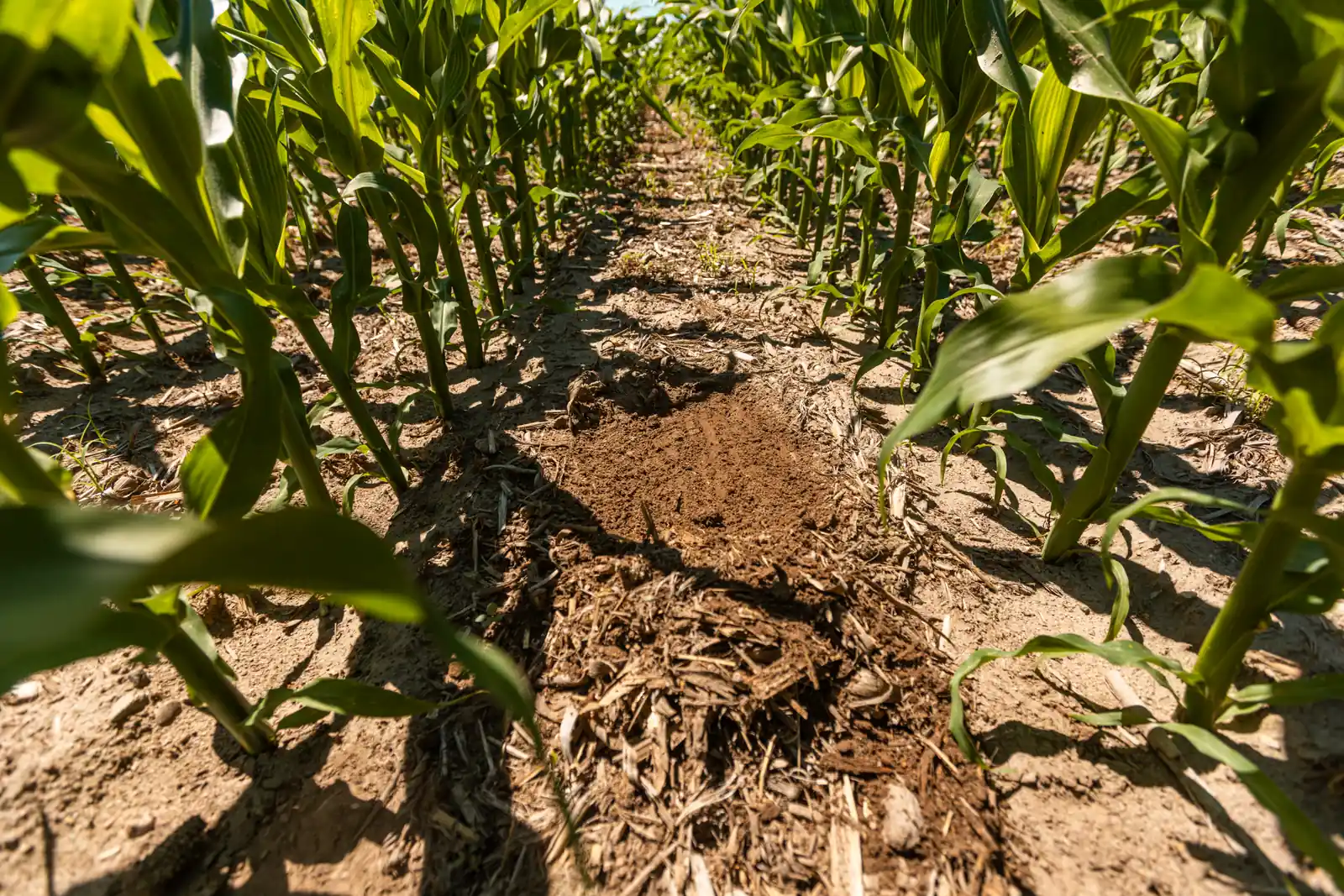
Strip-till involves loosening only the narrow strip of soil in which the plants grow. The space between rows remains undisturbed and covered with crop residues.
This operation allows loosening, subsurface fertiliser application and seeding to take place in just one machine pass, protecting the soil against drying out. The protective straw layer acts as a natural insulator. It shields the soil from the sun, limits water evaporation and lowers the temperature of the soil profile during hot weather.
Higher yields and protection of soil structure
Scientific research clearly confirms that giving up the conventional plough makes the field more resilient to extreme weather events. Strip-till brings farms measurable benefits:
- Erosion protection: Loss of the most valuable soil layer falls by as much as 95%.
- Maximum water retention: Surface runoff of rainfall decreases by 92%, allowing water to reach the root zone directly.
- Higher yields: Farmers record a 5.1% increase in crop yields and obtain 14.7% more straw.
- Biological activity: Avoiding soil compaction encourages earthworms, whose channels help heavy rainfall infiltrate deeply.
Czajkowski strip-till machines
Czajkowski strip-till cultivators are precision machines that break up the plough pan, apply fertiliser and sow seeds in just one pass without destructively inverting the soil. Their operation supports the restoration of the natural fine-aggregate structure and permanently prevents moisture evaporating from the soil profile. The manufacturer's portfolio is divided into two main product lines, ideally suited to farms facing increasingly severe water shortages.
ST series - heavy-duty cultivators for large-scale farms
The ST series strip-till cultivator is designed specifically for the largest farms and professional agricultural contractors working extensive fields with extremely challenging soil conditions.
Key specifications and features of the ST series:
- Working width: The largest models in this series reach widths of up to 6 metres, ensuring maximum productivity over vast areas.
- Fertiliser capacity: The machines have twin-compartment hoppers holding up to 4,900 litres, allowing prolonged work without frequent stops.
- Working unit configuration: Machines can be fitted with 4 to as many as 16 working units, capable of withstanding the highest mechanical loads.
- Electronic guidance: The cultivators have precision guidance systems based on advanced Trimble GFX-1060 displays.
STK series - compact machines with the off-set system
STK series strip-till cultivators meet the needs of farmers with medium-sized areas and tractors with lower draft power, rated at 160 to 250 hp.
Key specifications and features of the STK series:
- Working depth: The shanks' working depth can be adjusted continuously and without tools from 20 to 35 cm.
- Fertiliser capacity: Twin-compartment hoppers optimise the logistics of subsurface fertiliser application.
- Number of units and protection: The equipment offers 4 to 9 loosening units, with each working component protected by a hydraulic non-stop system.
- Off-set system: The asymmetrical arrangement of the working units relative to the tyre packer completely eliminates machine blockages and the pushing of large masses of crop residues.
Protect your crops against a lack of rainfall
Giving up conventional ploughing and adopting non-inversion tillage is the most reliable way to protect crops against the growing effects of climate change. Keeping crop residues on the field as mulch, combined with loosening the soil profile in strips, stores rainwater effectively. Another major benefit for the farm is the substantial saving in fuel and labour from reducing operations to just one machine pass.
Are you struggling with worsening erosion and want to improve water retention in your fields? Discover how dependable Czajkowski strip-till cultivators can help you stabilise yields: https://uprawapasowa.pl/.
FAQ - Frequently asked questions
What is soil erosion and what causes it?
Soil erosion is the destruction and movement of the top layer of soil, caused mainly by water and wind. In agriculture, conventional ploughing intensifies it by removing the field's protective cover and creating an impermeable plough pan. Without straw on the surface, rainfall runs off across the field, washing away humus and worsening drought.
How can you effectively retain water in soil?
Effective water retention requires stopping the inversion of the furrow slice, maintaining a permanent mulch cover and rebuilding the soil's crumb structure. Straw left on the surface reduces evaporation, protects the soil against heating and acts as an insulator. In addition, deep vertical loosening without a plough breaks up compaction, allowing rainfall to infiltrate quickly and reach the roots directly.
How does strip-till prevent water loss and erosion?
Strip-till prevents water loss by reducing rainfall runoff by 92% and limits erosion by 95% compared with ploughing. The technology involves loosening only a narrow seed strip and leaving undisturbed inter-rows covered with straw. Combining loosening, fertilising and seeding in one pass protects the soil against drying out and lowers its temperature.
Which strip-till cultivator should you choose for a medium-sized farm?
For farms with a medium-sized area, the optimum choice is a compact cultivator from the Czajkowski STK series, designed for tractors rated at 160 to 250 hp. These machines feature an asymmetrical arrangement of working units in an off-set system that prevents blockages from crop residues. The cultivator offers a working depth adjustment range of 20 to 35 cm, hydraulic non-stop protection and the option of combining it with PS seeding attachments or PSP planters.