
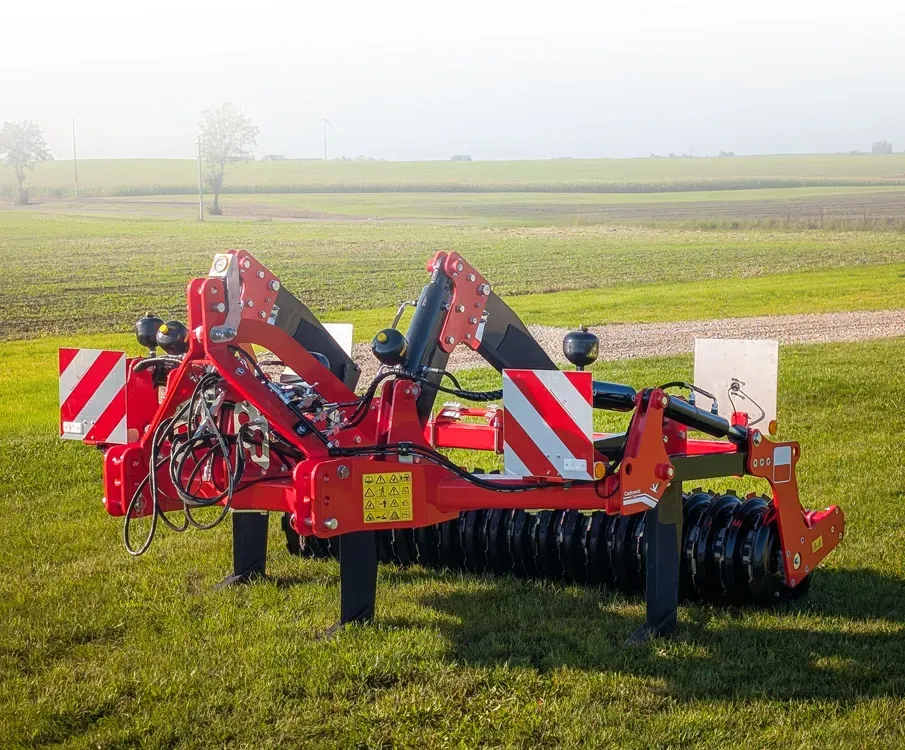
How to subsoil a field correctly?
Correct subsoiling involves loosening a compacted soil layer without inverting the soil profile. The operation improves the balance of water and air and helps crop roots develop. The most important steps are to locate the plough pan beforehand, select the appropriate working depth and carry out the operation at the right soil moisture level. Find out when and how to subsoil a field to achieve the expected results.
When is the best time to subsoil a field?
The best time for subsoiling is usually the post-harvest period in late summer and early autumn. After harvest, it is easier to plan deep loosening without disturbing a growing crop. In favourable conditions, the operation can also be carried out at another time, but the condition of the soil at working depth is decisive. Before the next sowing, allow time for the soil to settle and for proper preparation of the field surface. Subsoiling should not be carried out routinely, but only after identifying compaction that restricts crop development.
In what weather conditions should a field be subsoiled?
Subsoiling is best carried out when the soil at the intended working depth is dry enough to fracture and crumble under the action of the tines, but is not excessively dry. Soil that is too wet smears and deforms plastically, which can lead to renewed compaction of the profile. Conversely, excessively dry soil increases draught resistance, fuel consumption and the risk of large clods forming. There is no single optimum moisture level for every site, so conditions must be assessed individually, taking soil type and structure into account.
How can you assess soil moisture before subsoiling?
Soil moisture can be assessed provisionally with a simple field test, taking a sample from the layer to be loosened. This check helps determine whether the soil is suitably friable or remains too plastic. It is worth testing several places in the field, as conditions can vary between sites. The test does not replace a moisture measurement, but helps with the decision on whether to start work.
- Take a soil sample from the intended working depth, preferably at several points in the field.
- Squeeze a lump of soil in your hand and check whether it deforms easily.
- Gently press the lump you have formed and observe how it behaves.
- If the soil smears easily and forms a plastic mass, postpone the operation. If it fractures and breaks into smaller aggregates, conditions may be suitable for work.
How do you determine the correct subsoiling depth?
Subsoiling depth should be determined from the position of the lower boundary of the compacted soil layer. In practice, the operation is often carried out at a depth of around 30-50 cm, but the correct setting depends on the actual location of the plough pan. The working elements are usually set around 5-10 cm below the lower boundary of compaction to loosen the problematic layer effectively. Working too shallowly may not produce the expected result, while excessive depth increases power requirements and operating costs.
How do you locate the plough pan?
The easiest way to locate a plough pan is with a soil penetrometer or a soil pit. A penetrometer measures soil resistance at different depths, while a soil pit allows the profile structure and root development to be assessed. Measurements should be taken in several places at comparable soil moisture, because dry conditions can inflate penetrometer readings. Accurately identifying the depth of compaction allows the subsoiler to be set correctly and avoids unnecessarily increasing working resistance.
How should light and sandy soils be subsoiled?
Light and sandy soils should be subsoiled only when a compacted layer restricting root growth or water movement has been identified. On these sites, deep mechanical intervention is not always justified, because naturally permeable soil may not require additional loosening. Unnecessary disturbance of the profile can increase the risk of drying and water moving below the root zone. Therefore, prior soil diagnosis is the most important step, along with limiting the depth of the operation to the site's actual needs.
How should heavy clay soils be subsoiled?
Subsoiling heavy clay soils requires particular care when choosing the timing and machine settings. Soils with a high clay content are prone to plastic deformation when excessively wet, so the operation should be carried out when the compacted layer can fracture effectively under the action of the working elements. The choice of finishing roller also matters, as it helps level the surface and break down clods. For the Czajkowski VT 300 subsoiler the manufacturer recommends, among other options, a U-profile roller or a DD ring roller with a diameter of 600 mm. Matching the equipment to field conditions makes it possible to combine deep loosening with proper preparation of the soil surface.
How often should a field be subsoiled?
Subsoiling can be considered every few years, for example at intervals of 3-5 years, but this is not a fixed agronomic rule. The frequency primarily depends on soil type, tillage intensity, loading by agricultural machinery and the recurrence of compaction. On farms using strip-till or other systems that reduce the intensity of soil disturbance, monitoring the profile and avoiding unnecessary passes are particularly important. Subsoiling is worth repeating only when soil examination confirms the need, rather than solely on the basis of a predetermined schedule.
Summary - the key principles of correct subsoiling
Effective subsoiling primarily requires an accurate diagnosis of compaction, the right working depth and appropriate timing. Working in excessively wet soil or without first identifying the plough pan can reduce the operation's effectiveness and increase tillage costs. Correctly performed loosening helps improve water infiltration, soil aeration and root development, although the scale of the benefits depends on site conditions. Read more about the effects of this operation in the article: https://uprawapasowa.pl/en/blog/benefits-of-subsoiling-three-key-advantages
FAQ - Frequently asked questions
What does subsoiling a field involve?
Subsoiling involves mechanically loosening a compacted soil layer without inverting the soil profile. The operation helps improve soil permeability, aeration and conditions for root development.
When is the best time to subsoil a field?
Subsoiling is best carried out after harvest, in late summer or early autumn, when the soil at working depth is sufficiently friable. However, the actual soil condition matters more than a particular month.
How deep should subsoiling be carried out?
Subsoiling is often carried out at a depth of around 30-50 cm. The working elements should usually operate around 5-10 cm below the lower boundary of the compacted layer, identified by examining the soil.
Should subsoiling be carried out every year?
No, subsoiling does not need to be repeated annually. It is carried out as needed, after identifying soil compaction that restricts root development.
Does subsoiling improve water retention in soil?
Subsoiling can improve water infiltration and its availability to roots if a compacted layer previously restricted water movement. However, the effect depends on soil type, structure and weather conditions.