
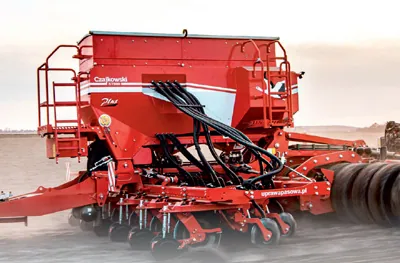
How were Czajkowski machines created? From need to patent
Czajkowski machines arose from the need to optimise work on the family farm, leading to the development and patenting of proprietary strip-till technology. This article explains how a modest prototype welded in a home workshop evolved into the advanced ST and STK series, saving up to 50% in fuel and effectively protecting soil moisture. Farm managers face rising fertiliser prices, soil drought and diminishing time within short agronomic windows every day. Discover the story of a Polish manufacturer built by a team of 56 practitioners, whose machines sowed more than 115,000 hectares in Poland alone in 2022.
How were Czajkowski machines created? A need on 750 ha
Czajkowski machines were created while searching for a way to reduce water evaporation and lower fuel and labour costs. Although the farm now covers 750 hectares, in 2004-2006, including leased land, it extended to as much as 1,800 hectares. Managing such a vast area by conventional methods required work day and night.
“I remember ploughing, cultivating and sowing—three tractors, six operators and countless breakdowns. You worked yourself to exhaustion, then a downpour came and washed it all away.” — Maciej Czajkowski
Increasing drought, damaged soil structure and an acute lack of time at the height of the season forced a move away from ploughing towards strip loosening. With no machines meeting the demanding agronomic criteria, the owner decided to create his own design from scratch.
The beginnings of Czajkowski—needs from its own fields
The brand began directly on the family farm in Sokołowo. In 2007, Maciej Czajkowski used a strip-till sowing service for the first time. Although the idea impressed him, the available machines had serious flaws: they were not versatile, while separate sowing and fertilisation placed fertiliser too shallowly. The core concept became deep loosening, sub-soil fertilisation and sowing in one pass. The farm’s own facilities allowed the sowing sections to be tested immediately without commercial risk.
Maciej Czajkowski—designer and farmer in one
From an early age, Maciej Czajkowski combined farm work with a passion for making and improving things. Together with his father, Piotr Czajkowski, he visited foreign and Polish agricultural machinery factories, including Grimme, Duro France and Unia Grudziądz. Newly purchased machines often went straight to the workshop for proprietary improvements. Practical experience ranging from machine operation to office management helped him precisely identify factory shortcomings in seed drills. Being both an active farmer and a designer ensured that the new equipment could cope with the toughest field conditions.
How did the first Czajkowski strip-till drill evolve?
Development accelerated in autumn 2013 after a challenge from his brother, Tomasz Czajkowski. With a welder and a mechanic, Maciej built the first ST section. By spring 2014, the first unit was ready and successfully sowed 300 hectares of sugar beet. It evolved from a simple set attached to a cultivator into an advanced no-plough design. A 2015 prototype gained offset working sections and a modified hopper. Each change eliminated clogging with crop residues and improved seed-to-soil contact, laying the foundation for a mature sowing system.
The breakthrough patent for the Czajkowski no-plough unit
The patent covers a unique design for the loosening and fertilising section and its integration with the seed drill. The innovation precisely places fertiliser vertically at two depths in the soil profile while preparing a strip seedbed. As roots grow downwards, vertical nutrient application encourages deep rooting. The patented system effectively breaks the plough pan and works in difficult, compact soils. It performs equally well in cereals, maize and rapeseed and in demanding vegetables such as onions, broccoli, celery and carrots.
From the first prototype to serial ST production
The move to serial production came in 2016 at the urging of neighbouring farmers impressed by field results on the test farm. The company sold 17 serial machines in 2017. Rapid strip-till development initiated the ST range for large acreages. Measurements showed fuel consumption falling to 18-22 litres per hectare, with much shorter working times and less equipment required. Strong market interest transformed the home workshop into a modern factory.
Where are Czajkowski machines made today?
Czajkowski machines are made in a modern plant in Sokołowo, in Poland’s Kuyavian-Pomeranian Voivodeship. The brand’s entire history is tied to Polish capital and production in one place. Unlike companies assembling ready-made components, the factory carries out the full process from scratch using high-quality abrasion-resistant steel. It has laser cutters, welding robots and paint booths. The neighbouring test farm enables improvements to be introduced immediately.
A modern Czajkowski agricultural machinery factory
The Polish factory employs 56 specialists, including engineers, welders and automation experts responsible for precise frames and hydraulic systems. Production uses proprietary CAD/CAM designs and modern satellite systems for variable fertiliser and seed application. Its own R&D department continuously analyses machine performance across Europe. Want to view the equipment or speak with an adviser? Visit contact to arrange a meeting.
ST and STK series: equipment for every field
The range includes the flagship ST series for medium and large farms and the lighter STK series designed for lower tractor power. ST units offer working widths from 3 to 6 metres and can cover dozens of hectares daily. STK answers the needs of farmers with tractors from 150 hp. See full specifications and equipment options among our strip-till machines.
A Polish strip-till machine manufacturer and industry development
As a leading Polish strip-till machine manufacturer, Czajkowski shapes the development of no-plough agronomy in Europe. Field trials show that strip technology retains up to 30% more moisture in the soil profile than conventional ploughing. In 2022 alone, Czajkowski units sowed more than 115,000 hectares in Poland, while total machine sales exceeded several hundred. This success confirms that Polish engineering competes effectively with global agricultural corporations.
Summary—Polish success in strip-till
Czajkowski’s journey from a 750-hectare test farm and a workshop challenge in 2013 to leadership in strip technology proves that agricultural machines grow from practical experience. Proprietary patents, its own Sokołowo factory and real field testing deliver equipment that cuts fuel costs and protects soil structure. Explore these agronomic solutions, choose equipment that improves crop profitability and arrange a field demonstration with our advisers.
FAQ—Frequently asked questions
Who founded Czajkowski agricultural machinery and is its chief designer?
Maciej Czajkowski, a practising farmer and entrepreneur, is the founder and chief designer. He used years of experience on the family farm to create equipment for difficult soils. Combining practical agronomic knowledge with a passion for engineering, he developed proprietary loosening and sowing sections from scratch.
When was the Czajkowski strip-till machinery brand established?
The brand was established in 2016, when the first serial machine was produced and sold after successful field tests. The first prototype was built in a home workshop in autumn 2013 and tested on 300 hectares of sugar beet in spring 2014. Interest from neighbouring farms subsequently turned the workshop into a professional production plant.
Where are the Czajkowski factory and production facilities?
They are in Sokołowo, Kuyavian-Pomeranian Voivodeship. The plant completes the whole production process in one location using advanced laser cutters, welding robots and paint booths. Its proximity to the 750-hectare test farm lets designers verify changes immediately and continuously improve machines under field conditions.
What inspired the Polish manufacturer to build its own strip-till unit?
It was inspired by the need to address soil drought and high fuel costs and the lack of time to cultivate its own farm. Conventional ploughing was costly and damaged soil structure, while available no-plough machines lacked versatility. A challenge from the designer’s brother ultimately prompted the proprietary 2013 build.
Which innovations and patents distinguish the history of Czajkowski machines?
The key innovation and patent is a proprietary strip-loosening system that simultaneously applies fertiliser at two depths. It breaks the plough pan and encourages vertical root growth, greatly improving water uptake during drought. The design integrates deep loosening with pneumatic sowing of cereals, maize, rapeseed and vegetables in one pass.