
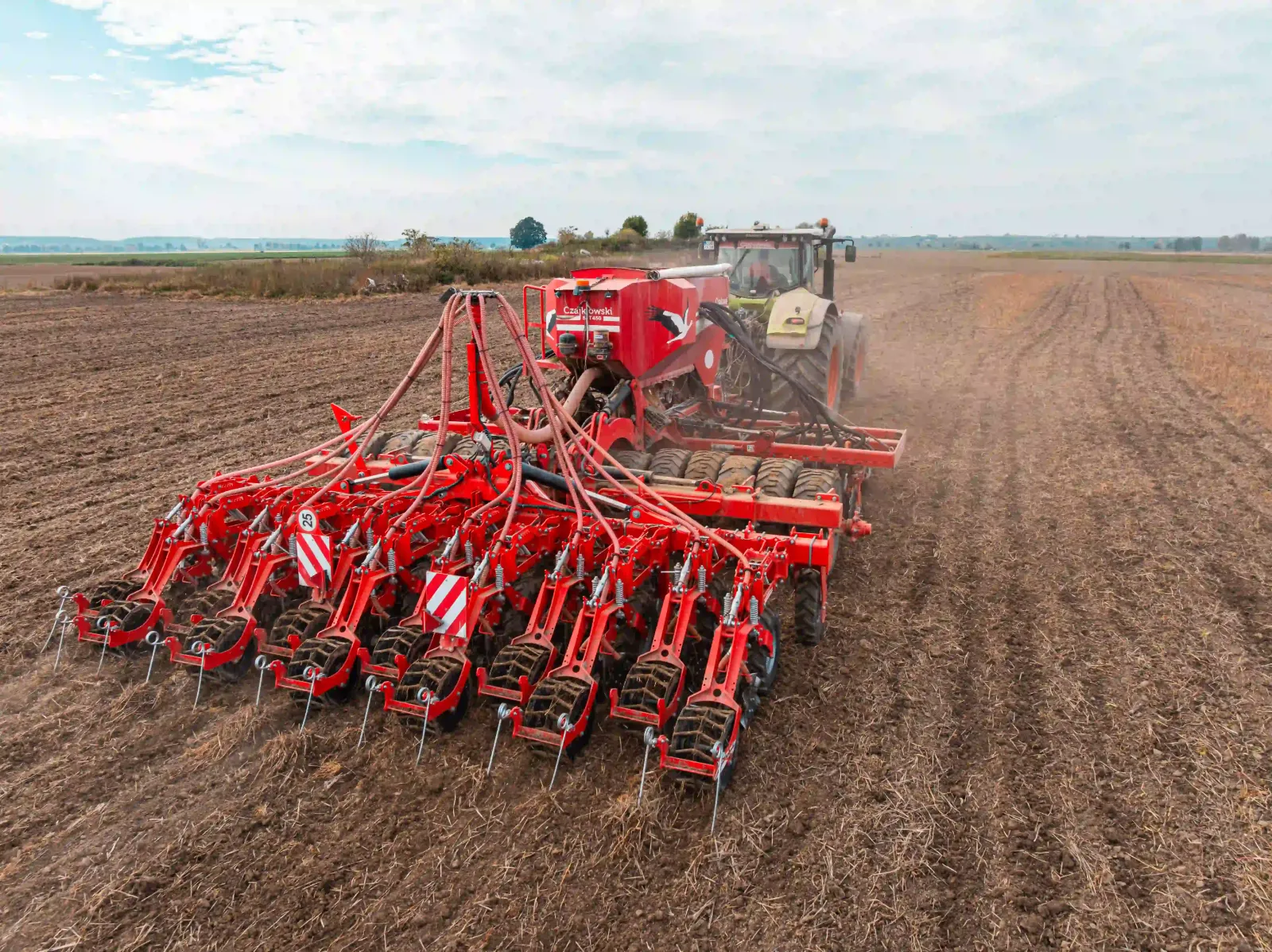
What to do with crop residues in no-till farming?
Managing crop residues in no-till farming involves chopping them appropriately, distributing them evenly and using them as soil surface cover. Retained biomass reduces water evaporation, protects against erosion and provides organic matter. Too much straw, however, can hinder sowing and delay soil warming. Find out how to manage crop residues correctly and use Strip-Till to prepare the soil for the next crop.
How do crop residues affect soil fertility and humus content?
Crop residues provide organic matter and nutrients that gradually return to the cycle as biomass decomposes. Retained straw supports soil microorganism activity, promotes soil aggregate formation and can contribute to increased organic carbon content. However, the rate of these processes depends on temperature, moisture, residue type and the carbon-to-nitrogen ratio (C:N). Straw with a high C:N ratio can temporarily reduce nitrogen availability, because microorganisms use nitrogen during decomposition. Retained biomass should therefore be accounted for in the fertilisation balance rather than treated as a complete replacement for mineral fertilisers.
How should crop residues be managed after harvest?
Crop residue management should begin during combine harvesting, ensuring that residues are chopped evenly and spread across the full working width. Unevenly distributed straw can form thick layers that hinder seed-to-soil contact, reduce emergence uniformity and increase the risk of blockages in sowing components. In a no-till system, appropriate biomass preparation is particularly important because it is not fully mixed into the soil. Proper chopping and even residue spreading make subsequent cultivation easier and help maintain uniform field surface cover.
The basic principles of crop residue management include:
- Even straw spreading - correctly setting the combine chopper and spreader to avoid biomass accumulations.
- Adjusting the degree of chopping - cutting stems and straw according to the preceding crop and planned cultivation system.
- Controlling biomass quantity - assessing residue layer thickness and considering partial removal where justified.
- Choosing the cultivation system - preparing the field by direct drilling, shallow cultivation or Strip-Till, depending on conditions.
- Monitoring decomposition - observing residue condition, soil moisture and any disease symptoms before the next sowing.
How should maize crop residues be managed?
Maize crop residues require particular attention because of the large biomass volume and tough stalks that decompose relatively slowly. After grain harvest, stalks should be chopped thoroughly and the remains distributed evenly over the field surface. Increasing the area of contact between residues and soil can accelerate decomposition, but its rate still depends on moisture, temperature and microorganism activity. Leaving large amounts of undecomposed maize residues can hinder sowing of the next crop and increase the risk of certain fungal diseases, so appropriate crop rotation and monitoring field health are also important.
How does Strip-Till help manage crop residues?
Strip-Till allows narrow soil strips to be prepared for sowing while leaving the inter-row areas largely undisturbed and covered with plant residues. As the implement passes, working elements move biomass away from the seed strip and then loosen the soil where plants will develop. This can reduce problems caused by seed contact with residues and promote faster warming of exposed strips compared with surfaces covered by thick mulch. However, strip tillage does not replace correct straw spreading behind the combine, because uneven biomass can still hinder machine operation and affect sowing quality.
An example of equipment designed for these conditions is the Czajkowski ST strip-till implement range, equipped with clearing and tearing discs that remove crop residues from the strip. A wavy cutting coulter cuts into the soil, while a vertical tine allows loosening to a depth of 35 cm without inverting the profile. With the right configuration, the technology combines strip preparation, deep fertiliser placement and sowing, reducing the number of separate field operations.
What are the benefits of retaining crop residues as mulch?
Leaving crop residues on the soil surface creates a natural protective layer that limits direct exposure to sunlight, wind and heavy rainfall. Mulch helps reduce water evaporation and protect the field surface against water and wind erosion. Under favourable conditions, it can also support rainwater infiltration and reduce soil crust formation. Supplying organic matter is another long-term benefit, contributing to humus formation and improvements in soil properties.
The main benefits of crop residue mulch are:
- Reduced evaporation - the biomass layer reduces the direct effects of sun and wind on the soil surface.
- Erosion protection - residues reduce the blowing away of soil particles and soften the impact of raindrops.
- Improved infiltration - surface cover can reduce runoff and help water enter the soil profile.
- Organic matter supply - biomass decomposition gradually releases nutrients and supports biological activity.
- Reduced crusting - mulch helps protect the topsoil against forming a compact crust after heavy rainfall.
When can retaining crop residues cause problems?
Excessive crop residues can make field preparation difficult and negatively affect the next crop's development, particularly during a cool, wet spring. A thick mulch layer limits soil warming, can delay drying and hinder correct seed placement. Pathogens overwintering on plant residues pose an additional risk, especially where crops susceptible to the same diseases are grown frequently. Retaining all biomass is not always the best solution, so the decision should depend on the preceding crop, residue quantity, weather conditions and planned crop rotation.
Which machines work well in fields with large amounts of residues?
Choosing machinery for fields covered with crop residues depends on biomass quantity, soil type and the field preparation system. In Strip-Till, seed-strip clearing elements, suitable working-section design and the ability to operate without excessive straw accumulation are important. Czajkowski offers ST and compact STK implements using clearing and tearing discs and vertical loosening elements. The right configuration enables seed strip preparation while retaining residues between the rows, combining soil surface protection with precise cultivation.
Explore Czajkowski machines for no-till and Strip-Till farming and choose a solution suited to your farm's conditions.
Summary - how can crop residues be used effectively?
Correct crop residue management in no-till farming requires appropriate straw chopping, even biomass distribution and a sowing system suited to field conditions. Retained mulch can protect soil against erosion and moisture loss, but excess mulch can cause emergence problems and disease development. Strip-Till helps reconcile surface residues with the preparation of exposed seed strips. The best results come from combining proper biomass management, crop rotation and suitably selected machinery, not simply leaving straw after harvest.
FAQ - Frequently asked questions
What are crop residues and what do they include?
Crop residues are plant remains left in the field after the main crop is harvested. They include straw, stubble, chaff, stem and leaf fragments, and root system remains.
Should crop residues be chopped?
Yes, appropriate chopping of crop residues makes even distribution easier and can accelerate biomass decomposition. However, the degree of chopping should be adapted to the crop type and the planned cultivation system.
Can you sow directly into crop residues?
Yes, sowing into crop residues is possible with suitably adapted machinery. In Strip-Till, exposed seed strips are prepared while a substantial proportion of biomass remains between the rows.
What are the benefits of retaining crop residues?
Retaining crop residues reduces erosion, decreases water evaporation and supplies organic matter. Their gradual decomposition supports soil biological activity, although excessive mulch can also hinder sowing and delay emergence.
Which Czajkowski machines work well in fields with crop residues?
Czajkowski ST and STK implements are designed for strip tillage in fields with crop residues. Their working sections clear mulch from the strips and loosen the soil, leaving the inter-row areas largely undisturbed.