
Strip Till and fuel savings – how much you really gain
The cost gap: ploughing versus strips
Fuel costs are one of the largest items in a farm's budget. The traditional plough system requires 4 to 6 separate tractor passes over the same field.
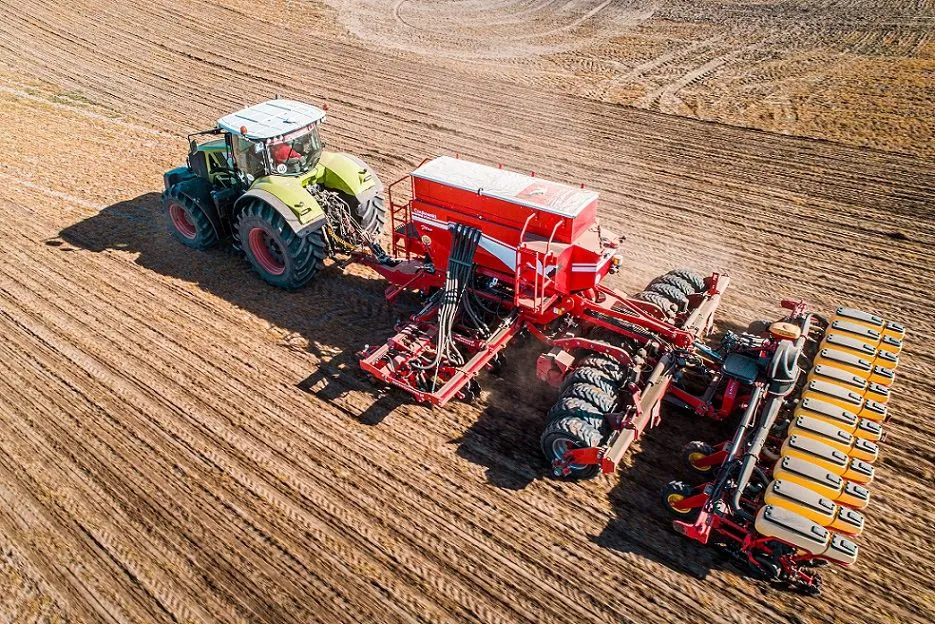
Strip-till performed with the Czajkowski ST unit lets you complete cultivation, fertilisation and sowing in a single pass. That radically reduces the number of engine hours per hectare.
The savings come from the fact that we loosen only about 30% of the field surface. Less soil resistance means lower engine load and a fraction of the previous fuel burn.
Fuel consumption in the traditional system
The plough system starts with stubble breaking (5–7 l/ha). Then comes ploughing, the heaviest operation, consuming 15 to 25 l/ha depending on soil compactness.
The next stages are fertiliser spreading (2 l/ha), cultivation with a power harrow (6 l/ha) and sowing (5 l/ha). This requires many machines and favourable weather at every stage.
In total, the farm uses from 33 to over 45 litres of diesel per hectare to bring the crop to emergence.
Fuel consumption in the Strip Till system
Strip-till units do all the work in a single entry. The average burn with a Czajkowski ST unit fitted with a seeding attachment ranges from 14 to 18 l/ha.
The figure includes deep loosening, NPK fertiliser application and precise seed placement. The difference is 20 to 30 litres per hectare in favour of strip-till.
On an area of 100 ha this gives, in a single season, 2000 to 3000 litres of saved diesel that stays in the tank.
Machine depreciation and operator time
Fuel savings are only the first component of the financial relief. Reducing the number of passes extends the life of tractors and lowers service costs.
Instead of maintaining a plough, a disc harrow and a seed drill, we concentrate operating costs on a single specialised machine.
Fewer engine hours allow sowing to be done in the optimal window by a single operator, eliminating staffing problems.
Matching tractor power to the machine
For fuel to be optimised, the tractor must have a reserve of pulling power. Too weak an engine at maximum revs generates high fuel consumption.
For machines in the STK series, tractors of 150–200 HP work well, providing a speed of 10–12 km/h without overloading the unit.
The powerful 6-metre ST-series units require tractors above 350 HP as well as proper ballasting and tyre pressure.
The influence of field conditions on fuel use
Soil compactness is the main factor of working resistance. On light soils, fuel burn in strip-till can drop below 12 l/ha.
Moisture also matters – optimally moist soil "cuts" more easily than dried-out clay.
Thanks to the coulter cutters in Czajkowski machines we have reduced the resistance of the tine entering the ground, which lowers the drivetrain load.
FAQ – Frequently asked questions
What is the real fuel burn in Strip Till when growing oilseed rape?
On medium soils of class III–IV the real consumption with a Czajkowski ST machine is 15–18 l/ha and includes loosening, fertiliser application and sowing.
Is a 120 HP tractor enough for a 3-metre machine?
No. The minimum power for smooth operation of a 3-metre machine (STK series) is 150 HP, to avoid engine overload and slip that reduces performance.