
What is no-inversion tillage? A step-by-step guide
No-inversion tillage involves abandoning traditional ploughing in favour of deep soil loosening without turning it over. Mulch from crop residues left on the surface creates a natural shield that protects the soil from water evaporation, erosion, and overheating. Switching to this system reduces fuel costs by up to 50% and facilitates free root development. In this guide, we explain step-by-step how you can safely implement no-inversion tillage on your farm.
No-inversion tillage step by step - how to prepare the site?
Preparing a site for no-inversion tillage requires assessing soil compaction, straw shredding, and deep loosening combined with fertilisation. The correct sequence of operations prevents waterlogging and ensures uniform plant emergence.
Switching to this system requires farmers to change their approach to managing crop residues in the field. Below, we discuss three key stages of preparing the site for tillage without ploughing.
Step 1: Field diagnostics and plough pan elimination
Plough pan elimination consists of breaking through the compacted soil layer at a depth of 30 to 45 cm without bringing dead subsoil to the surface. The plough pan hardens as a result of many years of pressure from shares and heavy equipment, cutting off root access to water.
The presence of this barrier can be checked with a field penetrometer or by creating a soil profile pit. To effectively break up compaction at great depth, a subsoiler with high under-frame clearance is used, which eliminates the problem of the machine clogging with residues.
Step 2: Crop residue management and mulching
Proper management of crop residues requires their thorough shredding and even distribution in the field during combine harvesting. The resulting layer of organic mulch protects the soil from wind and sun and reduces rainwater runoff by up to 92%.
In the case of a large amount of plant biomass after maize or rapeseed, shallow stubble cultivation is performed to a depth of 3-5 cm. This operation prevents the clogging of seed coulters, accelerates straw decomposition, and facilitates seed germination.
Step 3: Strip loosening and deep placement of fertiliser
Strip-till involves working only narrow strips of soil for sowing, while leaving the inter-row area undisturbed. This layout allows for two-level fertiliser application directly into the root zone, which significantly improves the uptake of nitrogen and phosphorus by plants.
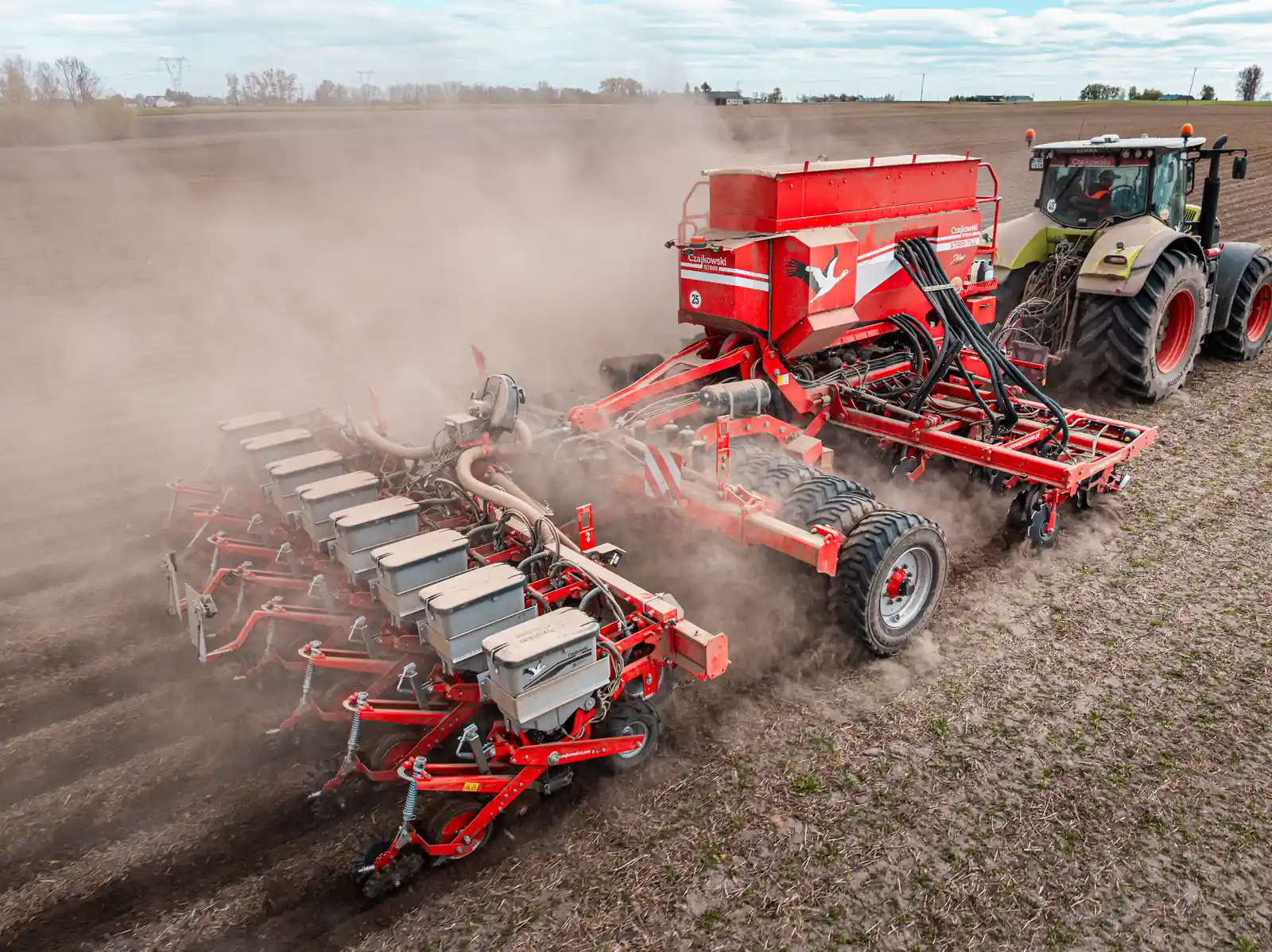
Using an integrated strip-till unit allows you to combine soil loosening, fertiliser application, and seedbed preparation in one pass. This provides significant fuel savings and retains moisture in the soil, which is essential for immediate emergence.
No-inversion tillage - to what depth should the soil be loosened?
The optimal soil loosening depth in no-inversion tillage is 20 to 35 cm, depending on soil compaction and the type of crop grown. Shallow stubble cultivation is used only to interrupt water evaporation and stimulate the germination of self-seeded plants. The primary loosening is performed below the compaction zone, which aerates the soil without turning over the furrow and without mixing its genetic layers.
Recommended tillage depths for specific crops:
- Cereals and winter rapeseed: depth 20-25 cm using narrow chisels
- Maize and sugar beet: depth 25-35 cm with an 80 mm wide chisel, which allows for the development of a strong taproot
- Leguminous plants: depth 20-25 cm, creating optimal conditions for the development of the root system and nodulation.
Why is no-inversion tillage profitable for every farmer?
No-inversion tillage in the strip-till system reduces production inputs by combining soil loosening, deep fertilisation, and seed sowing in a single working pass.
Key benefits:
- Reduced fuel consumption: average fuel burn decreases, which in large farms generates savings reaching hundreds of thousands of zlotys annually
- Savings in time and equipment: fewer passes reduce tractor wear and shorten working time in the field
- Higher subsidies: the system facilitates obtaining funds, which speeds up the return on investment in machinery
Start no-inversion tillage with Czajkowski technology
No-inversion tillage using strip-till technology effectively protects moisture, breaks the plough pan, and rebuilds the soil's natural structure. Performing deep loosening, deep fertilisation, and sowing in one pass streamlines field work, increases the farm's overall efficiency, and secures crops against erosion and the effects of drought.
Do you want to increase the efficiency of work on your farm? Check out the full range of Czajkowski machines for no-inversion tillage: https://uprawapasowa.pl/.
FAQ - Frequently asked questions
What is no-inversion tillage?
No-inversion tillage is based on eliminating the plough and loosening the soil without turning it over, while keeping crop residues on the surface. Organic mulch protects the soil from erosion, overheating, and water evaporation. In strip-till technology, only the strips of soil intended for sowing are loosened, which lowers fuel consumption.
To what depth should no-inversion tillage be performed?
Essential no-inversion tillage should be performed to a depth of 20 to 35 cm depending on the plant species and the level of subsoil compaction. Shallow stubble cultivation at 3-8 cm is used to interrupt evaporation and stimulate self-seeded plants. Deep work with a chisel at 25-35 cm for maize or beets breaks the plough pan without bringing dead soil to the surface.
How to prepare the soil for no-inversion tillage?
Preparing the soil for no-inversion tillage requires assessing its compaction, eliminating the plough pan, and thoroughly shredding crop residues. Deep subsoil compaction is removed with a subsoiler to a depth of up to 45 cm even before strip sowing. Straw should be spread evenly during combine harvesting, which prevents the formation of organic mass clusters and the blocking of seed coulters.
What is the power demand for no-inversion tillage units?
The minimum power demand for a 3-metre no-inversion tillage unit starts from 160 hp. To ensure proper machine operation in difficult conditions, the power conversion factor should not exceed 100 hp per one metre of the frame's working width. Larger 6-metre sets require a tractor with power from 250 to 350 hp.
What are the best machines for no-inversion tillage?
The best no-inversion tillage machines include Polish Czajkowski strip-till units combined with subsoilers and PSP precision seeders. The STK series design uses an off-set system with staggered wheel layout, which eliminates equipment clogging with straw. These sets combine loosening, soil fertilisation, and sowing in one pass, cooperating with PTx Precision Planting agricultural electronics systems.