
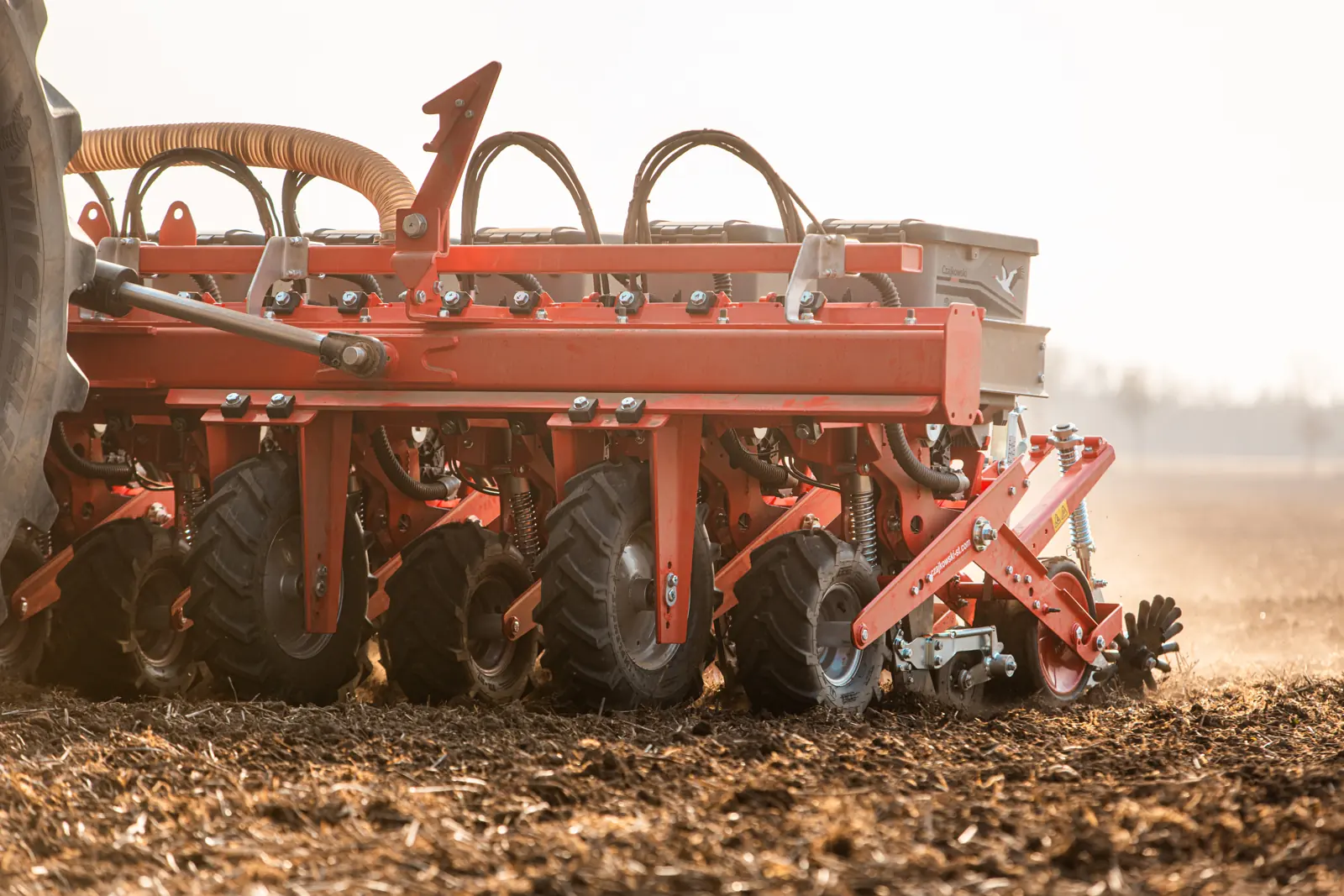
Precision planter - how to choose the best equipment for your farm?
Choosing the right precision planter is a decision that directly affects the productivity and profitability of your entire crop production. The right machine must combine accurate seed placement with a high working speed. These very challenges led to the development of the Czajkowski PSP series of planters, which effectively prevent errors in seed distribution and noticeably reduce operating costs. In this article, we discuss the most important equipment selection criteria in detail to help you make the right decision.
What requirements must a good precision planter meet?
A good precision planter must place seeds at a uniform depth, eliminate gaps in the rows and maintain accuracy even at high travel speeds. When selecting a machine for your farm, focus on solutions that speed up fieldwork and prevent seed losses.
Before buying, assess 4 key elements:
- Seed meter: accurately separates individual seeds drawn from the hopper.
- Seed delivery system: efficiently delivers each seed to the bottom of the furrow, preventing it from bouncing off the tube walls.
- Digital control (ISOBUS): enables convenient seeding-rate adjustment and planting monitoring from the tractor cab.
- Modular frame: allows quick changes to row-unit spacing for maize, beet or cereals.
Seed placement accuracy and the machine's working speed
Travelling fast with a conventional planter reduces planting accuracy, because falling seeds bounce off the tube walls and are placed irregularly in the soil. Exceeding 8 km/h with conventional designs leads to gaps in the rows because the seeds cannot keep pace with the machine's movement.
Active seed delivery systems solve these problems by guiding each seed and matching its delivery speed to the tractor's travel speed. This drive system allows much faster planting while maintaining ideal spacing between plants.
ISOBUS systems - why choose automation?
It is worth choosing ISOBUS so that you can control all planter functions from a single terminal in the tractor cab, without having to install additional screens and wiring. Working within one digital standard gives the operator continuous control over planting accuracy and working depth.
Automation also enables the use of prescription maps for variable-rate seeding, allowing more seeds to be planted on more fertile soils and fewer on poorer parts of the field. This makes work simpler and reduces the farm's seed consumption.
Versatility - a precision planter for vegetables and cereals
A versatile precision planter allows different types of crops to be planted using a single machine. This is based on a modular frame with variable row spacing and the ability to match the width of the loosening points to the particular crop.
Changing the settings allows a smooth transition from planting cereals in narrow strips to planting maize, sugar beet or vegetables with wide inter-row spacing. Choosing a machine with a flexible design makes it easier to manage the entire crop rotation and increases the profitability of the machinery fleet.
Czajkowski PSP precision planters - technology for profit
Czajkowski PSP precision planters combine robust mechanics with advanced PTx Precision Planting electronics, protecting crops against planting errors and increasing farm profitability.
The equipment was designed for farmers who prioritise a high work rate while reducing expenditure on seed. Digital control of each row unit, combined with a heavy-duty frame, delivers uniform crop emergence and reliable operation, even on demanding soils.
vDrive drives and vSet meters - perfect metering
vSet 2 meters and vDrive electric drives ensure accurate singulation of seeds, regardless of their size or shape. Electric control of each row unit prevents the slippage that causes uneven seed spacing in conventional planters.
The system allows the seeding rate to be changed dynamically while travelling and automatically shuts off row units in overlapping areas. In addition, full prescription map support enables the seed rate to be matched precisely to soil quality in different parts of the field.
How do SpeedTube delivery tubes neutralise the effect of gravity?
The SpeedTube system eliminates the negative effect of gravity by using an active conveyor belt that carries seeds from the meter to the bottom of the furrow. Seeds falling freely through conventional tubes bounce uncontrollably at higher speeds, resulting in unnecessary gaps in the rows.
In SpeedTube delivery systems, belt movement is closely synchronised with the tractor's travel speed, so seeds enter the soil without any displacement. As a result, the operator can safely increase the working speed in the field to as much as 16 km/h while maintaining even spacing between plants.
Curve Compensation - optimal plant population on bends
Curve Compensation automatically adjusts the rotational speed of each seed meter to the turning radius, ensuring uniform seed placement across the full width of the machine. When turning or planting along a curve, the planter's outer row units travel a much longer distance than the inner units.
Without continuous correction, this leads to excessive plant density on the inside and clear gaps on the other side. Intelligent real-time metering adjustment prevents lodging in overly dense stands and ensures a stable yield in every part of the field.
Choose a Czajkowski precision planter and reduce costs on your farm
Investing in a modern precision planter is a proven way to reduce operating expenses and improve crop profitability. The right machine reduces fuel consumption, prevents seed waste and avoids costly breakdowns during the critical fieldwork window.
Are you looking for solutions that will increase profits on your farm? Visit https://uprawapasowa.pl/ and contact our advisers to select equipment tailored to your needs!
FAQ - Frequently asked questions
What should you look for when choosing a precision planter?
When choosing a precision planter, pay attention to seed singulation accuracy, an active system for transporting seeds into the soil and full integration with the ISOBUS digital standard. The ability to work at high speed without the risk of gaps in the rows is also important. Check that the frame is modular, making it easier to change row-unit spacing for different crops. Thoroughly checking these parameters protects the farm against seed losses and breakdowns during the season.
What is the best precision planter for a farm?
The best precision planter is a machine with electrically driven row units and an active seed delivery system, such as the Czajkowski PSP, providing an accurate plant population at speeds of up to 16 km/h. The equipment uses vSet 2 seed meters and SpeedTube delivery tubes, which eliminate the effect of gravity on falling seeds. Curve compensation prevents excessive seeding density on bends, while support for prescription maps enables variable-rate seeding in fields with heterogeneous soils.
Which crops can a precision planter be used for?
A precision planter can be used for maize, sugar beet, oilseed rape, sunflower, soybean, as well as cereals and vegetables. The machine's flexibility comes from adjustable row-unit spacing on the frame and the selection of suitable seed discs. For cereals, seeds are placed in narrow strips, promoting better tillering. In wide-row crops, the design ensures even in-row spacing and uniform emergence.
How much does a Czajkowski PSP precision planter cost?
The price of a Czajkowski PSP planter depends on the number of working row units, the frame width and the selected precision farming equipment. The final price is affected by features such as SpeedTube delivery systems and prescription map support. Because of the modular construction and configuration for each individual farm, a quotation is prepared to order. Contact our technical adviser to receive an offer tailored to your needs.