
Strip-till in sugar beet – fewer passes, better use of water
Strip-till can reduce field passes and fuel use, place fertiliser more precisely and help conserve soil water. With rising production costs and periodic water shortages, however, results depend on correct implementation of the whole system; effects on yield and soil vary with the site, weather and field practice.
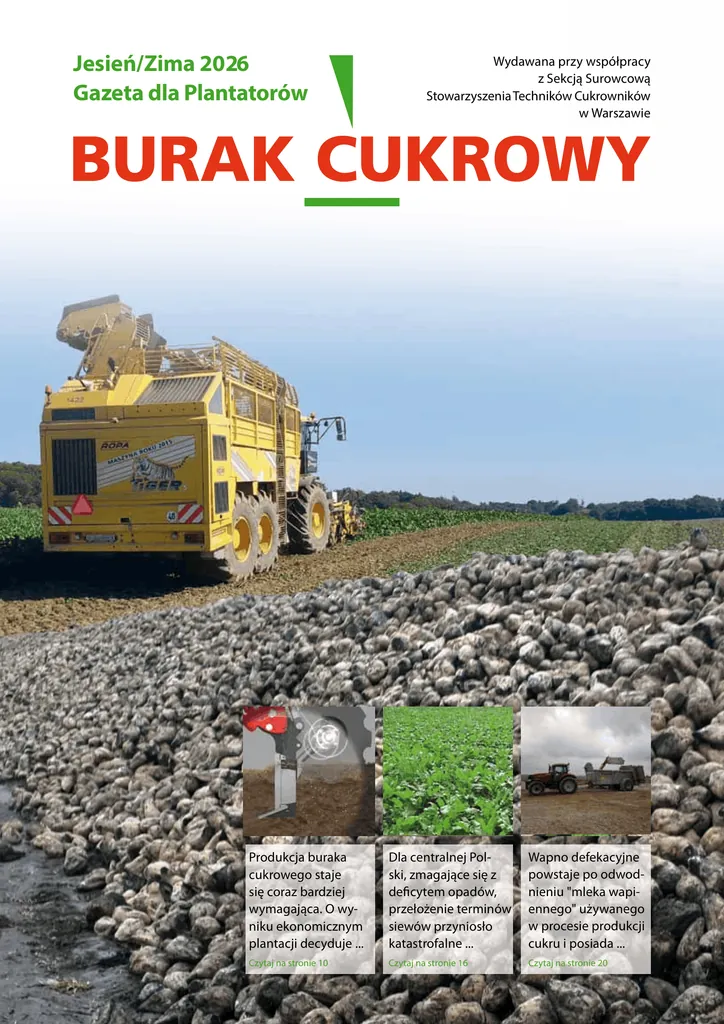
Koszty produkcji oraz dostępność wody dla roślin zadecydują o przyszłości uprawy buraka
This text is an editorial summary based on an article by Dr Marcin Łada of Nordzucker Polska S.A. The author’s complete Polish-language publication is available in the PDF above.
Why is strip-till gaining importance in sugar beet cultivation?
Sugar beet production is becoming increasingly demanding. The economic result depends not only on root yield, but also on the cost of achieving it, sugar content and the plants’ ability to cope with periodic water shortages.
Rising fuel, fertiliser and machinery costs increase the importance of technologies that reduce passes, improve nutrient use and limit water loss. One such solution is strip-till technology, or strip tillage.
What does strip tillage involve?
In strip-till, the soil is intensively loosened only in the strip where the plants will grow. The inter-rows remain less disturbed and may be covered with crop residue.
Depending on machine configuration, one pass can combine operations including strip preparation, fertiliser application, seedbed formation and, in a one-pass system, seeding. Strip-till is therefore not merely an alternative to ploughing, but a complete cultivation system.
Strip-till and water availability for sugar beet
Periods of water shortage at different stages of plant development are among the main challenges in sugar beet. Not only annual rainfall but, above all, its distribution during the growing season matters.
Water shortages can be particularly harmful during emergence and intensive root growth.
Why does retaining crop residue matter?
In strip-till, the inter-rows remain less disturbed and covered with plant residue. This layer limits direct heating of the soil surface, reduces evaporation and weakens the impact of raindrops.
In one Polish trial cited in the article, water reserves in the 0–20 cm soil layer were 82 m³ per hectare higher than under a plough-based system. This should not be treated as a guaranteed value for every field, because the effect depends, among other things, on soil and weather conditions.
How can strip-till affect sugar beet yields?
In Polish studies covering several sugar beet varieties, strip tillage increased average root yield by 6.6% and recoverable sugar yield by 8.2% compared with ploughing.
Importantly, the greatest difference was recorded in an extremely dry season, when the advantage in root yield was 11.6%.
This does not mean that strip-till will deliver a higher yield in every season. An important benefit may instead be reduced variation between seasons, especially where rainfall is deficient.
Fewer passes, lower fuel consumption and time savings
Conventional sugar beet field preparation can involve several separate operations, including ploughing, seedbed preparation, fertilisation and seeding. Each means another pass, more fuel and additional working time.
Strip-till can combine some of these operations.
Which operations can be completed in one pass?
Depending on the unit’s equipment, a single pass can:
- move crop residue away from the future row
- loosen the strip of soil
- apply fertiliser
- prepare the seed strip
- level and firm the soil
- precision-seed the crop
An example of a solution developed for this system is the ST600 12R PSP unit. In this Czajkowski Maszyny design, the individual working elements cooperate so that several operations can be completed in one pass.
How much fuel can be saved?
In studies directly concerning sugar beet cultivation, replacing deep ploughing with non-plough systems, including strip-till, reduced fuel consumption by 8.5–10 l/ha.
Even greater savings may occur when one strip-till pass replaces an entire series of separate operations. In the cited research, fuel use in such conditions was 35.9–45.8 l/ha lower and working time 114–152 minutes per hectare shorter than in an extensive plough-based system.
The actual farm result will nevertheless depend on the previous cultivation system, machines used, number of passes and working depth.
Precise fertilisation in strip-till
Strip tillage also makes it possible to place fertiliser precisely within the loosened strip.
With conventional broadcast fertilisation, nutrients are spread across the whole field. A young sugar beet root system initially uses only part of the soil volume.
In strip-till, fertiliser can be placed closer to the future root zone, reducing the distance between the plant and available nutrients.
Can strip-till reduce fertiliser rates?
Using strip tillage does not automatically mean that fertilisation can be reduced substantially from the first season.
The first benefit is primarily the potential to improve nutrient-use efficiency. Any reduction in rates should be gradual and preceded by soil nutrient analysis, yield results and root quality assessment.
Reducing fertiliser too quickly without monitoring plant nutrition can cancel out the benefits of the new technology.
How can strip-till affect soil properties?
Not all the benefits of strip tillage are visible in the first season.
Limiting intensive soil mixing and retaining crop residue may, over time, favour higher organic matter content, better soil structure and greater biological activity.
Benefits may accumulate over successive years
In an eight-year study, organic carbon content in soil under one-pass strip-till was 9.4% higher than in the plough-based system.
Higher levels of available phosphorus, potassium and magnesium were also recorded. This does not mean, however, that fertiliser rates can automatically be reduced by values corresponding exactly to these differences.
The results mainly show that long-term strip tillage may affect the soil’s capacity to store nutrients and water.
For this reason, the full effects of strip-till should not be assessed on the basis of a single season.
How should strip-till be introduced on a farm?
Strip tillage requires suitable preparation and precise execution.
Important factors include:
- even chopping and distribution of crop residue
- the correct timing of the operation
- an appropriate working depth
- the condition of working elements
- accurate guidance of the unit
- soil moisture conditions
Too much straw directly in the row can impair seeding quality, while an incorrectly prepared strip can affect the timing and uniformity of emergence.
On heavy and excessively wet soils, it is particularly important to avoid working in conditions that promote smearing and compaction of the strip.
Must strip-till be used on the entire area immediately?
A farm does not have to begin implementation by buying its own machine or changing the entire area to strip-till.
Options include:
- using a contractor
- sharing equipment
- starting strip tillage on part of the area
This makes it possible to compare fuel consumption, emergence quality, root yield and sugar yield under the conditions of the individual farm.
Is strip-till profitable in sugar beet?
When assessing sugar beet cultivation technology, it is worth considering not only yield itself but, above all, the cost of producing a tonne of roots and sugar.
Strip-till may allow:
- fewer passes
- lower fuel consumption
- more precise use of fertilisers
- more water to remain in the soil
- gradual improvement of selected soil properties
Greater production stability may be especially important in seasons when insufficient rainfall limits yield potential.
Strip tillage does not guarantee a high yield regardless of conditions. Correctly implemented, however, it may increase the chance of making better use of the site, fertilisation and variety potential.
FAQ – Frequently asked questions
Does strip-till work for sugar beet?
Yes. Strip tillage can be used in sugar beet production. The studies cited in the publication indicate its potential to reduce fuel use and improve water management, fertilisation and yields. Actual results nevertheless depend on site conditions and correct implementation.
Can strip-till reduce fuel consumption?
Yes, because it can reduce the number of passes and allow several operations to be completed in one field pass. The saving depends on the cultivation system that strip-till replaces.
Can fertiliser be applied while strip-tilling?
Yes. Fertiliser can be placed directly in the loosened strip, closer to the zone in which the plant root system develops.
Can strip-till reduce fertiliser rates?
Changing to strip-till does not automatically mean that fertiliser rates can be reduced. Any changes should be based on soil nutrient analysis, yield results and observations of plant nutrition.
Does strip-till help retain water in the soil?
Leaving the inter-rows less disturbed and retaining crop residue on the surface can limit evaporation and help retain more water in the soil profile.
Must strip-till be introduced across the entire farm at once?
No. It can first be used on part of the area, or provided as a service, so its effects can be compared with the farm’s current cultivation system.